
.svg)
Executive Assistant for Venture Capital Firms in the US
At a glance
Executive Assistant for Venture Capital Firms in the US: What VC Partners Actually Need
In the high-stakes world of venture capital, the clock never truly stops. Deal cycles move at breakneck speeds, and the difference between capturing a unicorn and missing an investment opportunity often comes down to the quality of execution.
For partners in Private Equity, hedge funds, and investment management, the Executive Assistant has evolved from a traditional gatekeeper into a strategic Chief of Staff. This elite role requires more than managing administrative tasks. It needs a deep understanding of Capital Markets, Investment Strategies, and high-level Investor Relations.
Why EA Support in Venture Capital Is Different
VC firms operate with structurally different demands than most businesses hiring executive support.
Deal velocity. A partner might take six founder calls in a day, each requiring different preparation, follow-up, and tracking. Diligence on a hot deal can compress a normally multi-week process into 72 hours.
Founder-facing communication. EAs in VC firms frequently coordinate directly with founders and CEOs of portfolio companies, who expect a level of responsiveness and polish that reflects on the fund itself.
Event and network density. Demo days, LP meetings, founder dinners, and conference circuits (especially dense in the New York and San Francisco ecosystems) require constant logistical coordination, often planned around partners' unpredictable travel.
Confidentiality around unannounced deals. Term sheets, cap table details, and pre-announcement information require a level of discretion that goes beyond standard corporate confidentiality.
Small team, high leverage. Many VC firms operate with a handful of partners and minimal support staff. A single EA's effectiveness has an outsized impact on the entire firm's operating rhythm.
The EA who thrives in this environment isn't simply organized. They understand venture as an industry, move fluidly between founders and LPs, and can absorb ambiguity without needing constant direction.
What VC Firms Get Wrong When Hiring EA Support
Hiring for general corporate experience. A candidate from a large, well-resourced corporate environment often struggles in a venture firm's lean, fast-moving structure, where there's no dedicated IT desk or ops team to lean on.
Underestimating the founder-facing dimension. Many firms hire for partner support alone and overlook that the EA will regularly represent the fund to founders, a relationship-sensitive function that's easy to underweight in a job description.
Treating it as a one-person dependency. In a three- or four-partner fund, a single EA supporting the whole team becomes a single point of failure. If they're out during a live deal, there's often no backup plan.
Moving too slowly to fill the role. Ironically, firms that pride themselves on moving fast on deals often run a conventional 8–12 week hiring process for EA support, while the operational gap created by an empty seat compounds daily.
What Strong EA Support Looks Like at a VC Firm
Deal-cycle fluency. They understand the rhythm of a raise, from first call to term sheet to close, and structure their support around it rather than treating it like a generic calendar event.
Founder relationship management. They communicate with founders in a way that reflects the fund's brand: responsive, warm, and professional, without unnecessary friction.
Network coordination. They manage the constant flow of intros, follow-ups, and relationship-nurturing that keeps a partner's network active between deals.
Event and travel orchestration. Demo days, off-sites, and the conference circuit require an EA who can manage complex, often last-minute logistics across cities and time zones.
Discretion by default. Confidential deal information, cap table details, and LP communications require an assistant who treats discretion as the baseline, not an exception.
New York and San Francisco: Two Ecosystems, Similar Demands
New York's venture scene spans fintech, enterprise software, and an increasingly dense early-stage community, often operating alongside the city's broader private equity and hedge fund infrastructure. EA salaries for senior roles supporting VC partners in New York typically range from $95,000 to $130,000+, reflecting the same premium seen across the city's broader finance and investment sector.
San Francisco's market, tightly bound to the startup ecosystem it serves, often pushes compensation higher still. Bay Area EA roles supporting VC partners can reach $120,000 to $150,000+, with equity-adjacent compensation culture and elevated cost of living both playing a role.
In both markets, the underlying need is the same: an EA who understands venture's pace and is calibrated to operate within it from day one, not after a multi-month ramp-up period.
The Two Models VC Firms Use to Access EA Support
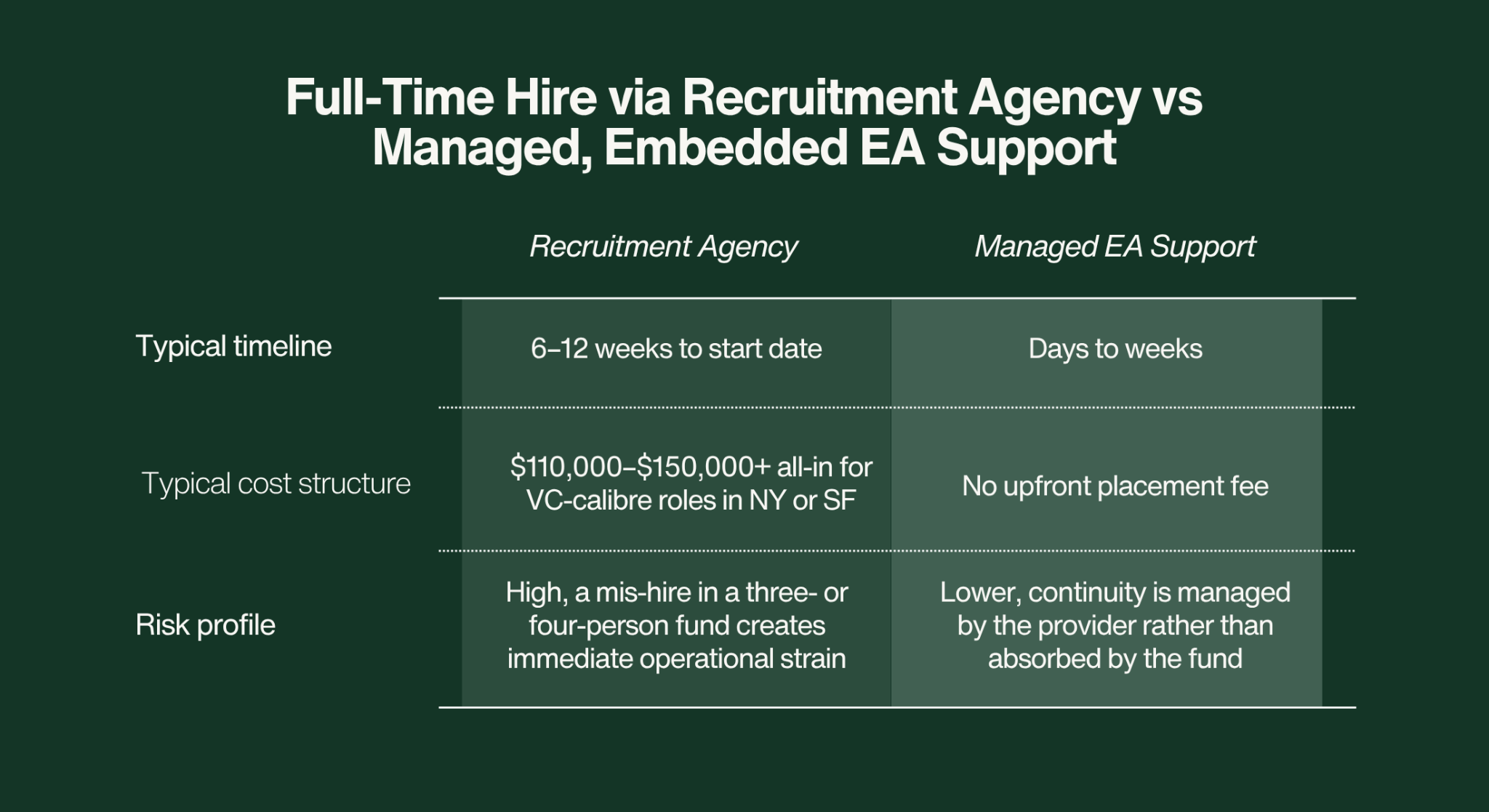
Model 1: Full-Time Hire via Recruitment Agency
The traditional path: engage a recruiter, run a search, interview candidates, extend an offer, and wait out a notice period.
Typical timeline: 6–12 weeks to start date
Typical first-year cost: $110,000–$150,000+ all-in for VC-calibre roles in NY or SF
Risk profile: High, a mis-hire in a three- or four-person fund creates immediate operational strain
This model works well for funds with stable, long-term headcount plans and the bandwidth to manage a direct hire properly.
Model 2: Managed, Embedded EA Support
A growing number of VC firms are accessing dedicated EA support through a provider that manages selection, onboarding, continuity, and quality, rather than running the search internally.
Typical timeline: Days to weeks
Cost structure: No upfront placement fee
Risk profile: Lower, continuity is managed by the provider rather than absorbed by the fund
For lean VC teams, this removes the most common failure points: the hiring gap, the cost of a mis-hire, and the single-point-of-failure risk inherent to small teams.
HireHarbour: Dedicated EA Support Built for Venture Capital
HireHarbour provides managed, embedded executive assistant support for venture capital firms, private equity firms, and founder-led businesses, including funds operating across New York and San Francisco's ecosystems.
What that looks like in practice:
- Pre-vetted for venture and investment workflows. EAs are assessed specifically for the pace, discretion, and founder-facing demands of VC firms, not just general EA competency.
- Fast deployment. Support is operational in days or weeks, removing the multi-month gap a traditional search creates.
- No placement fees. The cost structure removes the 15–25% upfront agency fee typical of a direct hire.
- Built-in continuity. For lean fund teams, this removes the single-point-of-failure risk a sole, internally-hired EA represents.
HireHarbour's model is designed for funds that move quickly on deals and want their operational support to move at the same pace, without the delay or rigidity of a traditional search.

Is This the Right Model for Your Fund?
Managed EA support tends to be the better fit when:
- Your fund needs experienced, founder-facing support quickly, not in two to three months
- You're a lean partner team where one EA's effectiveness has an outsized impact on the whole firm
- You want to avoid upfront recruitment fees and the operational risk of a mis-hire
- You need an EA who already understands venture's pace and discretion requirements, without a lengthy ramp-up
If your fund is actively hiring for EA support, or has experienced the strain of an empty seat during a live deal, it's worth comparing this model directly against a traditional search.
Conclusion
Venture capital's pace doesn't leave much room for a slow, rigid hiring process, and yet that's exactly what a traditional EA search often delivers. For funds in New York and San Francisco operating on deal velocity, founder relationships, and lean teams, the cost of an empty seat or a mis-hire is rarely just financial. It shows up in missed follow-ups, slower diligence, and partners doing work they shouldn't be doing.
HireHarbour's managed EA model was built for that reality: fast deployment, founder-calibre support, and continuity that doesn't depend on a single hire going right. For VC firms weighing how to structure support for the year ahead, it's worth comparing the true cost and speed of both models before defaulting to the traditional path.
For quick productivity insights, emerging trends in executive assistance, and practical guidance for high-performing teams, follow HireHarbour on LinkedIn. It’s time to make a difference!
Ready to make every second count?


.png)


