
.svg)
How Much Does an Executive Assistant Cost in New York?
At a glance
Hiring an executive assistant in New York is a critical inflection point for any growing business. It represents the vital transition from a founder "doing it all" to an organization that scales through effective delegation. Many leaders start their search by browsing platforms like Zip Recruiter. But the New York City market is more complex than a simple job board search shows. Hiring high-quality EA support is more than just picking a candidate; you must know the total pay, technical needs, and hidden costs that affect your work life.
This guide, "How to Hire Executive Assistants in New York 2026," gives you clear information. It helps you build a top support team in the Big Apple. It changes your view from seeing help as a cost to seeing it as a smart investment.
Typical Executive Assistant Salaries in New York
EA compensation in New York varies significantly by seniority, sector, and the complexity of the role.
Entry to mid-level EAs (1–4 years of experience) typically earn $70,000 to $90,000 per year in base salary. These roles usually support a single executive with relatively standard administrative responsibilities.
Senior EAs (5+ years, supporting CEOs, partners, or principals) typically earn $95,000 to $120,000+, with top-tier roles supporting senior leadership in private equity, venture capital, or hedge funds reaching $130,000 or higher. These figures align closely with data from Glassdoor, Robert Half, and Talent.com, which consistently place senior NYC EA salaries in the $95,000–$130,000 range as of 2026.
Family office and UHNW-adjacent EA roles often command a premium on top of these figures, reflecting the additional discretion and availability the role demands.
What Drives the Variation in Cost
Sector. EAs supporting finance, private equity, or venture capital firms typically earn more than those in general corporate environments. The complexity and confidentiality of the work commands a premium.
Seniority and scope. An EA managing a single executive's calendar is priced differently than one managing multiple stakeholders, overseeing junior staff, or handling elements of office management alongside executive support.
Discretion requirements. Roles involving exposure to sensitive financial information, M&A activity, or personal matters for principals typically command higher compensation, reflecting the trust placed in the role.
Hours and availability. EAs expected to be reachable outside standard hours, or to travel with executives, are typically compensated at the higher end of the range.
Recruitment Fees: The Cost Beyond Salary
If hiring through a traditional recruitment agency, expect to pay a placement fee on top of the EA's salary.
Most New York agencies charge 15% to 25% of the candidate's first-year salary, with the exact figure depending on the agency's specialization and the seniority of the role. For a senior EA earning $100,000, that translates to a recruitment fee of $15,000 to $25,000, paid before the EA has produced a single day of work.
Some boutique or highly specialized agencies charge toward the higher end of that range, particularly for roles requiring extensive vetting or UHNW-level discretion.
Total First-Year Cost: The Full Picture
Salary and recruitment fees are only part of the equation. A realistic total first-year cost also includes bonuses, benefits, and onboarding overhead.
For a senior EA in New York earning a $100,000 base salary:
- Base salary: $100,000
- Recruitment fee (20%): $20,000
- Bonus and benefits (10–15%): $10,000–$15,000
- Total first-year cost: approximately $130,000–$135,000
For EAs supporting principals at private equity or venture capital firms, where base salaries often exceed $120,000, total first-year cost can comfortably exceed $150,000.
These figures represent the direct, visible costs. They don't yet account for the costs that don't appear on an invoice.
The Hidden Costs Most Firms Don't Factor In
The hiring gap. A typical New York EA search takes 5 to 12 weeks from engagement to start date. During that window, the principal is absorbing tasks that should be delegated, at a real cost to their own productivity.
Ramp-up time. Even a strong hire takes several weeks to reach full productivity in a new firm, particularly in investment environments with specific workflows and sensitivities.
The cost of a mis-hire. Industry estimates put the cost of a failed hire at one to three times annual salary, once lost productivity, management time, and the cost of restarting the search are factored in. For a $100,000 EA role, that's a potential exposure of $100,000 to $300,000.
Management overhead. A direct employee requires ongoing management: reviews, HR administration, benefits coordination, and coverage during time off. In a lean team, this overhead typically falls on the principal rather than an HR function.
None of these costs show up on the agency invoice, but they're very real when budgeting for a hire.
How Costs Compare: Recruitment Agency vs Dedicated EA Support
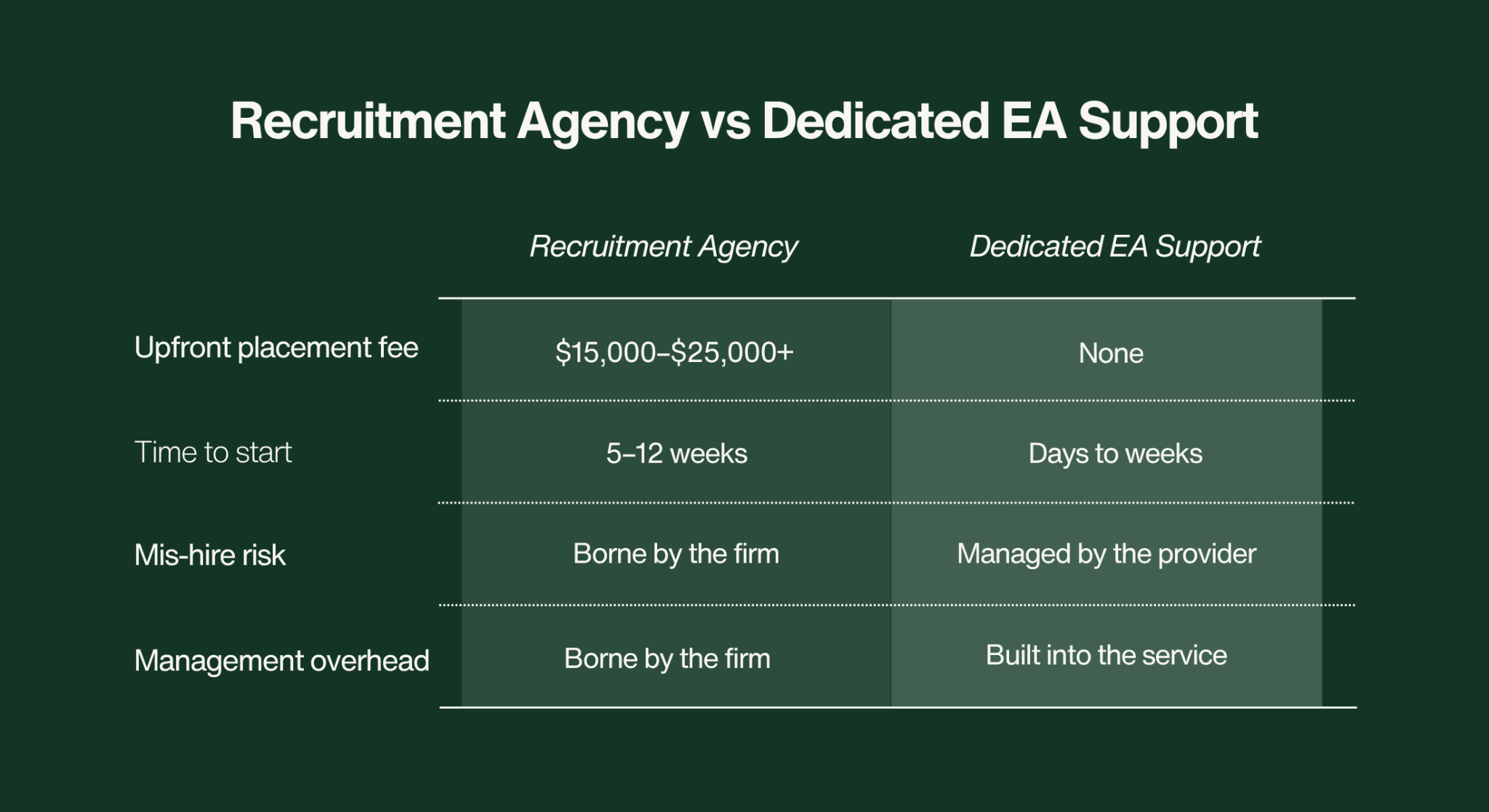
An increasing number of investment firms are weighing the full cost of a traditional hire against alternative models, particularly dedicated, managed EA support.
The appeal of the dedicated model isn't necessarily a lower base cost. It's the removal of the upfront fee, the hiring gap, and the mis-hire exposure that make traditional hiring expensive in ways that aren't always visible at the outset.
HireHarbour: A Different Way to Access EA Support
The figures above reflect the traditional hiring model: salary, recruitment fee, benefits, and the hidden costs that come with a direct hire. HireHarbour offers a different cost structure entirely.
Rather than recruiting an EA for you to employ directly, HireHarbour provides managed, embedded executive assistant support designed specifically for investment firms, family offices, and founder-led businesses. The model removes several of the costs detailed above:
- No recruitment fee. There's no 15–25% placement fee sitting on top of salary before a single day of work is delivered.
- No hiring gap. Support is operational in days or weeks, not the 5–12 weeks a traditional search typically takes, removing the productivity cost of an empty seat.
- No mis-hire exposure. Continuity and quality are managed by HireHarbour, not absorbed by the firm if a placement doesn't work out.
- No management overhead. Performance, coverage, and continuity are handled within the service rather than falling on the principal.
EAs placed through HireHarbour are pre-vetted specifically for investment firm workflows, so firms aren't paying a premium to discover, after the fact, whether a candidate can operate in a high-accountability environment.

For firms that have priced out a traditional New York hire and found the total cost, and the time, harder to justify than expected, this model is worth a direct comparison.
Conclusion
Hiring an Executive Assistant in New York costs more than the headline salary suggests once recruitment fees, bonuses, benefits, and the hiring gap are factored in. For senior, investment-firm-calibre roles, total first-year cost typically lands between $130,000 and $150,000 or more, before accounting for the harder-to-quantify risks of a slow search or a mis-hire.
That full picture matters more than the salary line alone. A traditional recruitment agency remains the right choice for firms that want a permanent, culturally embedded hire and have the time and infrastructure to manage that process well. But for lean investment teams where speed, flexibility, and reduced hiring risk matter more than long-term headcount planning, the cost comparison tells a different story.
HireHarbour was built for that second scenario. By removing the placement fee, the hiring gap, and the mis-hire exposure that drive up the true cost of a traditional search, it offers investment firms a more predictable and often more cost-effective path to EA support, without compromising on the quality or specialization the role demands.
If you're weighing the real cost of your next EA hire, it's worth comparing both models against your specific timeline, budget, and risk tolerance before committing.
For quick productivity insights, emerging trends in executive assistance, and practical guidance for high-performing teams, follow HireHarbour on LinkedIn. It’s time to make a difference!
Ready to make every second count?


.png)


