
.svg)
Recruitment Agency vs Dedicated EA: What Investment Firms and CEOs Actually Choose
At a glance
Comparing the traditional In-House EA model with the Managed Virtual EA route to help you choose the right support structure.
For high-performing business leaders, the most precious commodity is time. When your schedule spirals into "calendar chaos," the need for professional executive support becomes undeniable. Whether you are navigating the complexities of financial services or scaling a firm within the professional services sector, you are essentially searching for a "force multiplier": someone who can not only manage administrative work but also drive strategic alignment.
The dilemma often presents itself as a choice between two distinct paths: engaging recruitment agencies to secure a permanent, in-house team member, or partnering with a managed service provider to access a dedicated, remote, professional. Understanding the nuance between these models is critical, as it impacts not just your daily productivity, but your long-term operational overhead, data security posture, and leadership agility.
The Core Difference
A recruitment agency finds you a person. You then employ that person, manage them, and absorb the full operational and financial risk of that hire.
A dedicated EA model gives you the output: a skilled, embedded assistant who operates as an extension of your team, without the overhead of a direct hire.
The distinction matters more than it might initially appear.
When a Recruitment Agency Is the Right Call
Recruitment agencies remain the right choice in specific circumstances. It's worth being clear about when that is.
You want a permanent, in-house hire. If building institutional knowledge over years, with an EA who grows into the firm's culture, is the priority, a direct hire makes sense. The relationship compounds in ways a managed model isn't designed to replicate.
You have time to run a proper search. The agency model works well when there's no urgency. If you can absorb 10–14 weeks of searching, interviewing, and waiting out a notice period, the outcome can be excellent.
Your support needs are stable and predictable. For firms with consistent, long-term EA requirements and the bandwidth to manage a direct employee, the traditional model is well-suited.
You want on-site presence. Most managed EA providers, including HireHarbour, operate remotely. If physical presence in the office is a hard requirement, a direct hire gives you more options.
When Dedicated EA Support Is the Better Fit
The picture shifts considerably for firms operating under pressure, which, in practice, describes most investment teams.
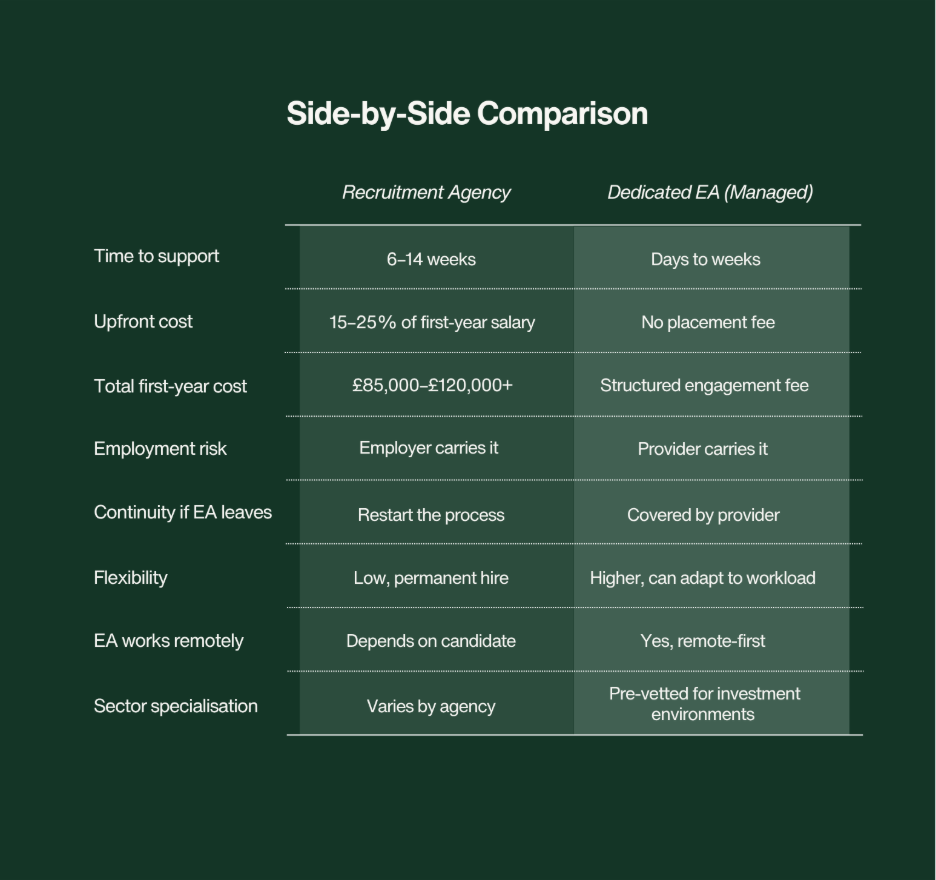
You need support now, not in three months. Deal flow doesn't wait for a hiring process. Neither does LP communication, board prep, or portfolio management. The 6–14 week agency timeline creates a gap that has a real cost for lean teams.
You want to eliminate upfront placement fees. A typical recruitment fee on a £70,000–£80,000 EA salary runs to £12,000–£20,000, paid before the hire has produced a single day of output. The dedicated model removes that entirely.
You're running a lean team where a mis-hire is costly. In a two or three-person investment team, a poor EA fit doesn't just create inconvenience. It creates operational drag during a rehire process that can take months. The managed model substantially reduces that risk.
Your workload fluctuates. Private equity and venture capital operate in cycles. The flexibility to adapt EA support as deal activity changes is a structural advantage the traditional model doesn't offer.
You want an EA calibrated to investment environments from day one. The ramp-up period for a generalist EA entering an investment firm is real and often underestimated. EAs placed through a specialist provider have already been assessed and prepared for that context.
The Hidden Costs Most Firms Don't Factor In
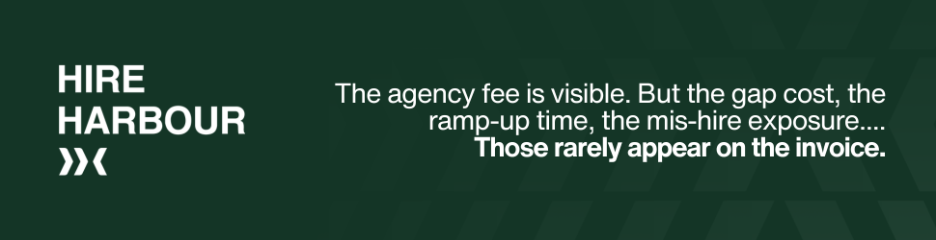
The agency fee is visible. These costs often aren't.
The gap cost. Six to fourteen weeks without EA support at the partner level has a measurable impact on principal time. Deal timelines slip. Operational tasks get absorbed by people who shouldn't be doing them.
Ramp-up time. Even a strong hire takes 4–8 weeks to reach full productivity in an investment firm environment. During that period, the principal is still carrying a significant portion of the operational load.
The mis-hire cost. Industry estimates put the cost of a failed hire at 1–3x annual salary when you factor in lost productivity, the management time spent handling the situation, and the cost of restarting the search. At EA salary levels for investment firms, that's a serious exposure.
Management overhead. A direct employee requires active management: performance reviews, HR processes, benefits administration, holiday cover. In a lean firm, that overhead falls on the principal.
None of these costs appear on the agency invoice. They're worth accounting for before making the comparison.
What Investment Firms and CEOs Typically Choose
The pattern that emerges across investment firms is fairly consistent.
Larger, established firms with dedicated HR functions and long-term headcount plans tend to use recruitment agencies for permanent EA hires. The infrastructure exists to absorb the process and manage the outcome.
Boutique PE and VC firms, family offices, founder-led advisory businesses, and search funds increasingly move toward the dedicated model. The reasons are structural: lean teams, fast-moving environments, variable workloads, and a low tolerance for the cost and disruption of a mis-hire.
The decisive factor is usually not cost. It's time and risk. Firms that have experienced a failed EA hire, or that have operated without adequate support during a long recruitment process, tend to be the most motivated to find a model that removes those variables.
HireHarbour's Model
HireHarbour provides dedicated, remote executive assistant support for investment firms, family offices, and founder-led advisory businesses in London.
The model is built around three priorities that matter in high-accountability environments:
Speed. Support is operational in days or weeks, not months. There is no recruitment cycle sitting between your need and your capability.
Precision. EAs are pre-vetted for investment firm workflows; assessed not just on EA competency but on the specific operating demands of PE, VC, and founder-led environments.
Continuity. Because support is delivered through a managed system, there is no single point of failure. If an assistant is unavailable, structured handover protocols mean your operations don't stall.
In most cases, one EA works exclusively with one client. For engagements requiring fewer hours, arrangements can be structured accordingly, but the standard is dedicated, not pooled.
There are no placement fees. No lengthy onboarding cycles. No employment risk carried by the client.

The Decision Framework
Before choosing a model, two questions tend to clarify the decision:
How much does the gap cost you? If your firm can absorb 10–14 weeks without EA support at the senior level, a traditional search is viable. If it can't, the dedicated model is worth serious consideration.
What's your tolerance for rehire risk? If a mis-hire would create significant disruption (operationally or financially) the managed model's lower risk profile is a material advantage, not just a convenience.
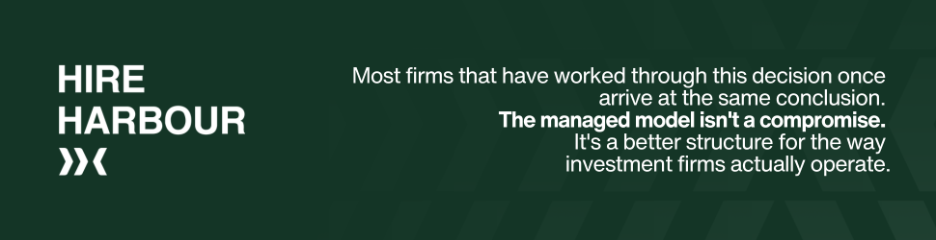
Most CEOs and investment partners who have worked through this decision once arrive at the same conclusion: the managed model isn't a compromise on quality. It's a better structure for the way investment firms actually operate.
Conclusion
The choice between a recruitment agency and a dedicated, managed EA service is not about which is "better". Instead, it is about which aligns with your organization's lifecycle and risk profile.
If your goal is to build an internal institution with a long-tenured, office-based presence, the recruitment agency model remains the traditional pre ference. Conversely, if your priority is speed, risk mitigation, and seamless, tech-enabled support, the managed service model provides a level of operational flexibility that is difficult to replicate in-house.
For quick productivity insights, emerging trends in executive assistance, and practical guidance for high-performing teams, follow HireHarbour on LinkedIn. It’s time to make a difference!
Ready to make every second count?


.png)


